A full practice run for the real thing, so test day feels familiar.
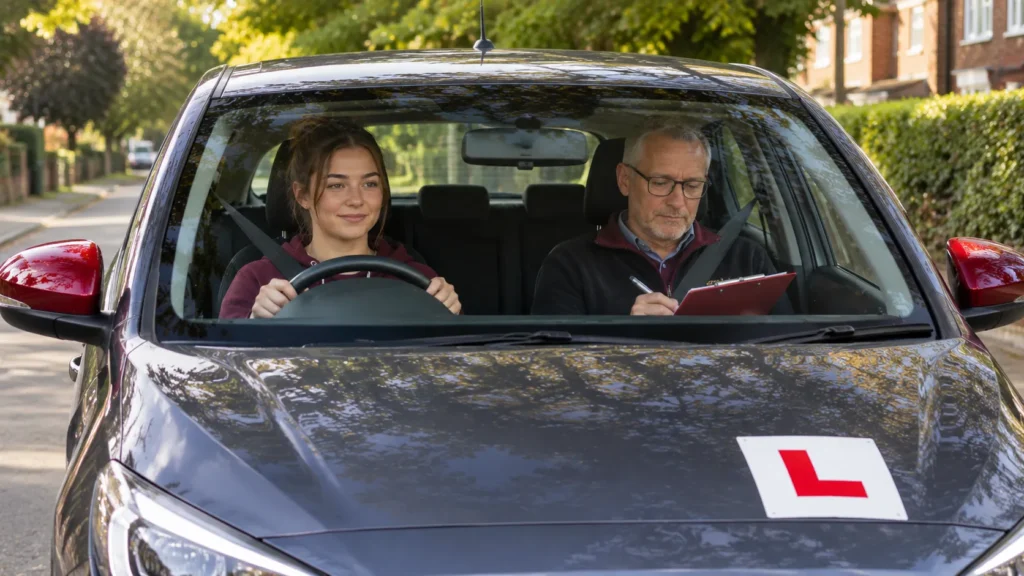
A mock driving test is a practice test with your instructor, set up to feel like the real thing. It’s one of the best ways to find out if you’re ready, and to calm your nerves before test day. In this guide, we explain exactly what happens on a mock driving test, how it’s marked and how to get the most from it.
At a glance
40 mins
about the same length as the real test
15
driving faults allowed on the real test
0
serious or dangerous faults allowed
Most learners feel nervous about the unknown. A mock driving test takes the unknown away. Once you’ve done one, you know how the test starts, how the examiner gives directions, and what it feels like to drive without help.
It also gives you and your instructor an honest picture. For example:
Instructor’s tip
Treat your mock test like the real thing. Wear what you’d wear on the day, bring your licence, and try to follow the same routine. The more real it feels, the more useful it is.
We usually do a mock driving test a few weeks before your real one. That way, there’s time to fix anything that comes up. Some pupils also have a second mock closer to the day, particularly if they feel nervous. In fact, a second mock is often the best confidence boost of all.
Our mock tests follow the same format as the real test. Your instructor plays the examiner, so they won’t help or give feedback until the end. Here’s how it runs.
First, you read a number plate from about 20 metres away. If you can’t, the real test wouldn’t go ahead. So it’s worth checking now. Read the eyesight check on your driving test.
You’re asked a tell me question before you drive, and a show me question while you’re driving. For example, you might be asked to show how you’d wash the windscreen while on the move. Read show me, tell me questions explained.
You drive on a mix of roads, such as busy junctions, roundabouts, dual carriageways and quieter estates. Your instructor gives directions just like an examiner, calmly and in good time.
For about 20 minutes, you follow a sat nav or road signs. If you go the wrong way, don’t worry. It isn’t a fault, as long as you drive safely. Read independent driving and the sat nav on your test.
You’re asked to do one manoeuvre, such as parallel parking, bay parking or pulling up on the right and reversing. You may also be asked to do an emergency stop. Read manoeuvres explained.
Finally, back at the start, your instructor tells you whether you would have passed. Then they go through every fault, explain why it was marked, and show you how to fix it.
Your instructor marks faults the same way as on the real test. There are three kinds:
| Fault | What it means | Example |
|---|---|---|
| Driving fault (minor) | Not dangerous, but not quite right | A slightly late signal on a quiet road |
| Serious fault | Potentially dangerous | Not checking your mirror before pulling out |
| Dangerous fault | Real danger to you or others | Another driver has to brake to avoid you |
On the real test, any serious or dangerous fault, or more than 15 driving faults, means a fail. So, on your mock, look out for patterns as well as single mistakes. For example, repeating the same driving fault can lead to a serious fault, because it shows a habit.
Afterwards, we go through how you got on and agree what to work on. Then we decide together whether you’re ready, using the DVSA’s Ready to Pass? checklist. See are you ready to pass?
If your mock shows you’re not quite there, that’s fine. In fact, it’s exactly why we do it. We’ll plan the next lessons around those areas, and you’ll go into the real test far better prepared.
A mock driving test is for learning, so don’t worry. In fact, mistakes now are useful, because you can fix them before the real thing. Many pupils have a shaky mock and then pass their real test comfortably.
The most common mock test faults we see are:
Read common reasons for failing the driving test to see what examiners pick up most often.
About 40 minutes of driving, the same as the real test. With the debrief, it fits easily into one of our 2 hour lessons.
We start near your test centre, either St Albans or Borehamwood, and use the kind of roads examiners use.
Yes. Lots of pupils have two, especially if they feel nervous. The second one often shows how much has improved.
It shouldn’t be. We mark it fairly and honestly, in the same way as an examiner would.
We give one-to-one manual driving lessons in Borehamwood, Colney Heath, Elstree, Harpenden, Hatfield, London Colney, Radlett, St Albans and Shenley.
A 2 hour lesson is £80, or save £20 with our 10 hour package for £380. We accept all major credit cards and PayPal.