How to pass the driving ability test, with tips from instructors who’ve done it.
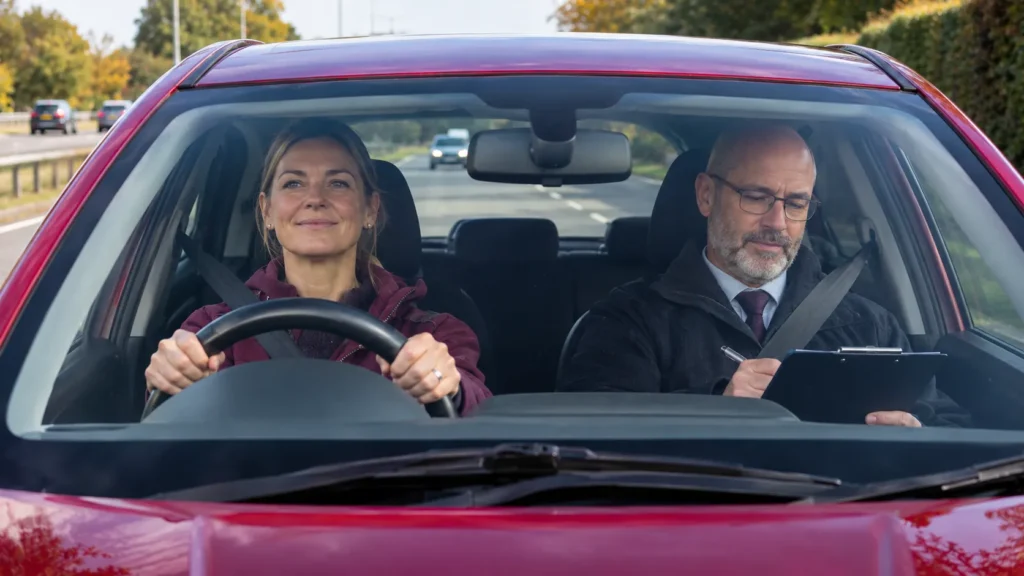
ADI Part 2 is the driving ability test for trainee instructors. It’s harder than the learner test, because the DVSA expects a high standard of driving from someone who will soon be teaching others. In this guide, we explain what happens on the ADI Part 2 test, how it’s marked, the faults that catch people out, and how to prepare so you pass first time.
At a glance
6
maximum driving faults allowed
3
attempts to pass ADI Part 2
1 hour
approximate length of the test
ADI Part 2 sits in the middle of the qualifying process. First, you pass the Part 1 theory and hazard perception test. Then you pass Part 2, your own driving. Finally, Part 3 tests your teaching. Read ADI Part 1, 2 and 3 explained for the full picture.
@h3 1. The eyesight check First, you read a number plate from 27 metres, or 27.5 metres for an older-style plate. If you can’t, you fail straight away, and it counts as one of your 3 attempts.
You’re asked 5 vehicle safety questions: 3 tell me questions before you drive, and 2 show me questions while driving. For example, you might be asked how you’d check the tyres, or to show how you’d demist the rear windscreen on the move.
You drive on a range of roads, including busy town roads, country roads and dual carriageways, and possibly motorways. The examiner will look for safe, smooth driving that makes good progress.
For around 20 minutes, you follow a sat nav or road signs. The examiner wants to see you plan ahead and make good decisions, not just follow directions.
You’re asked to do 2 manoeuvres from parallel parking, bay parking in or out, and pulling up on the right and reversing. You might also be asked to do an emergency stop.
To pass, you can make no more than 6 driving faults, and no serious or dangerous faults. That’s much stricter than the learner test, which allows up to 15 driving faults.
Learner test vs ADI Part 2
| Area | Learner test | ADI Part 2 |
|---|---|---|
| Driving faults allowed | Up to 15 | Up to 6 |
| Eyesight check distance | About 20 metres | 27 metres (27.5 for older plates) |
| Vehicle safety questions | 2 | 5 |
| Manoeuvres | 1 | 2 |
| Length | About 40 minutes | About 1 hour |
The examiner also looks at eco-safe driving, such as planning ahead, using gears sensibly and avoiding harsh braking. So drive smoothly and efficiently, as well as safely.
Trainees often fail for the same few things. So watch out for:
Trainer’s tip
Being too cautious is one of the most common reasons good drivers fail Part 2. Examiners want safe driving that also keeps up with the traffic. So when it’s safe to go, go, smoothly and without hesitation.
Most trainees benefit from several hours of training with an experienced ADI trainer. A trainer can spot habits you didn’t know you had, after years of driving. Then they help you replace them with the standard the DVSA expects.
Good training usually starts with an assessment drive. From there, a plan is built around your strengths and weaknesses, finishing with a full mock ADI Part 2 test.
If you fail ADI Part 2 3 times, you have to retake Part 1. Also, all parts must be passed within 2 years of passing Part 1. So it’s worth preparing properly rather than booking too early.
Once you pass Part 2, you can start preparing for Part 3. Some trainees also apply for a trainee licence, which lets you give paid lessons while you prepare. Read what is a trainee licence (pink badge)?
Yes. You’re allowed far fewer driving faults, you do more manoeuvres and the examiner expects a much higher standard.
Yes, as long as it meets the DVSA’s rules for the test. Check GOV.UK before your test, or use a trainer’s car.
It depends on your driving. Some trainees need a few hours, others need more. An assessment drive with a trainer is the best place to start.
You can book another test. However, you only have 3 attempts, so use the feedback to work on your weak spots first.
We offer instructor training packages. Read becoming a driving instructor: the honest pros and cons, or see Become a Driving Instructor.
Sources: GOV.UK: ADI Part 2 test.
We give one-to-one manual driving lessons in Borehamwood, Colney Heath, Elstree, Harpenden, Hatfield, London Colney, Radlett, St Albans and Shenley.
Instructor training with us: 2 hours for £90, 10 hours for £400, or 40 hours for £1,500.