How the clips work, how you score points, and how to pass.
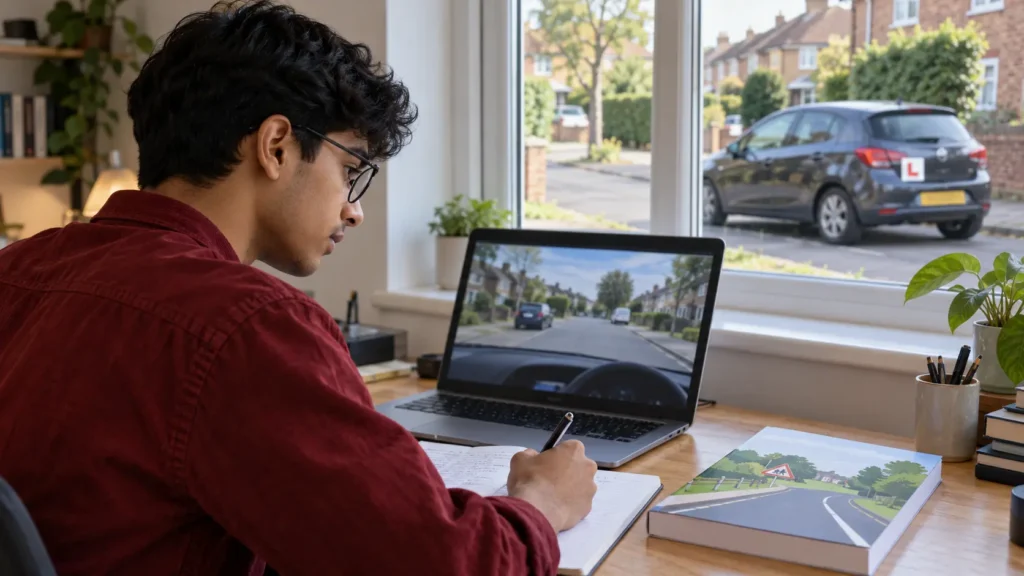
The hazard perception test is the second part of your theory test. It checks that you can spot danger early, which is exactly what keeps you safe on real roads.
First, you answer the multiple-choice questions. Then, after a short break, you watch a series of video clips filmed from a driver’s point of view.
Each clip contains at least one developing hazard. You click the mouse as soon as you see a hazard starting to develop.
A developing hazard is something that would make you change your speed or direction. For example, a child near the kerb who steps towards the road, or a car waiting to pull out of a side road.
A parked car on its own isn’t a developing hazard. However, if its reversing lights come on, it becomes one.
If you click continuously or in a pattern, you’ll score zero for that clip. So click when you first notice a possible hazard, and again as it develops. Two or three clicks per hazard is usually plenty.
The best hazard perception test tips are the same habits that keep you safe on the road. These are the ones our instructors see making the biggest difference.
Practice makes a real difference, because the test rewards quick reactions. Firstly, use the official DVSA practice clips, so you get used to the style and timing of the real test.
Secondly, practise on real roads. When you’re a passenger, try saying out loud what you can see developing ahead. In your driving lessons, we’ll talk through hazards with you too, so spotting them becomes a habit rather than a test skill.
You need 43 out of 50 in the multiple-choice part and 44 out of 75 in the hazard perception part. You must pass both parts to pass the test. Then your pass certificate number lasts for 2 years. Read the theory test: how to prepare and pass for more help.
If you don’t pass, try not to worry. Lots of learners need more than one attempt. You’ll have to take both parts of the theory test again, so keep revising the questions as well as the clips.
Meanwhile, you can still have driving lessons. That way, your practical driving keeps moving forward while you prepare for the retake.
We give one-to-one manual driving lessons in Borehamwood, Colney Heath, Elstree, Harpenden, Hatfield, London Colney, Radlett, St Albans and Shenley.
A 2 hour lesson is £80, or save £20 with our 10 hour package for £380. We accept all major credit cards and PayPal.