How to let them pass, safely, calmly and legally.
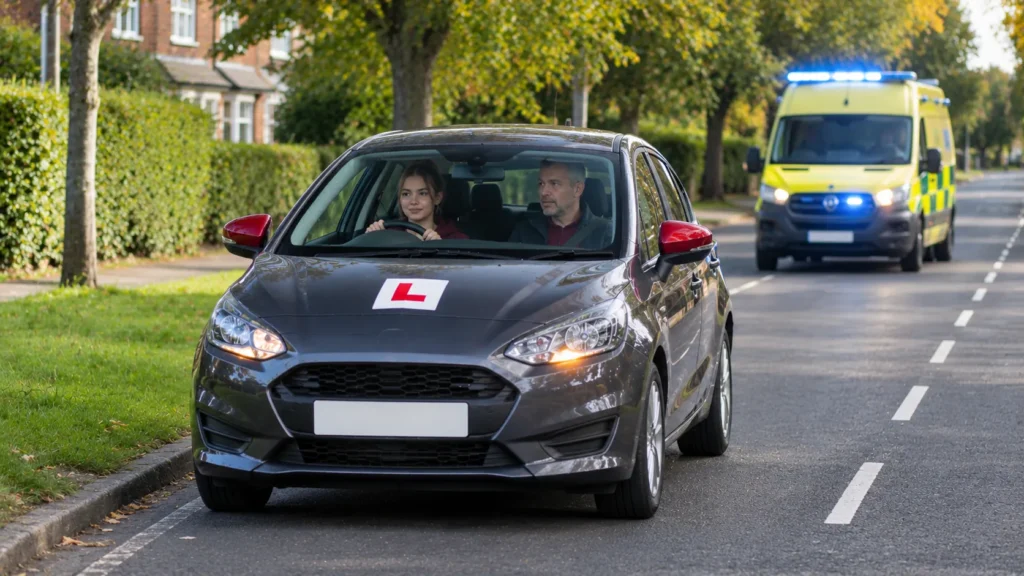
Hearing a siren behind you can be stressful, especially as a learner. Your heart races, and suddenly you’re not sure what to do. However, emergency vehicles just need you to help them get through safely. In this guide, we explain what the Highway Code says, what to do in common situations, and the mistakes to avoid.
At a glance
3 colours
blue, red or green flashing lights to look out for
0
red lights you should go through to let one pass
1
more vehicle is often following, so check again
The Highway Code tells you to look and listen for vehicles with flashing blue, red or green lights, headlights or sirens. Most often, emergency vehicles will be police cars, ambulances and fire engines. However, you may also see others, such as coastguard, mountain rescue, bomb disposal or blood service vehicles. Also, some doctors on call use green flashing lights.
Remember too that unmarked police cars can have blue lights hidden in the grille or windscreen. So if you see flashing blue lights in an ordinary-looking car, treat it the same way.
The Highway Code says to look and listen. So use your mirrors regularly, and keep music at a sensible volume. Then, when you hear a siren, work out where the vehicle is and where it’s going. It might be behind you, coming towards you, or approaching from a side road.
Instructor’s tip
Sirens can bounce off buildings, so it’s often hard to tell where they’re coming from. Check all your mirrors, then look ahead and to the sides before you decide what to do.
Don’t panic. Emergency vehicles need you to be predictable, not quick. Instead, think about where you can safely let the vehicle pass. Often, the best thing is to carry on calmly to a wider part of the road, then move a little to the left and slow down. Their drivers are highly trained, so they’ll usually find a way past.
The Highway Code says to make room while still following all traffic signs. So don’t go through a red light or drive into a bus lane to let them pass. You could cause a collision, and you could also get a fine or penalty points, because cameras don’t know why you did it.
Instead, wait at the red light. The emergency driver is trained to find a way past, and they’re allowed to go through red lights carefully when they need to.
@h3 On a straight road Check your mirrors, then move a little to the left where it’s safe and wide enough, and slow down. Keep moving if you can, because stopping dead can cause problems for the vehicles behind.
Stay where you are, unless you can move forward safely and legally without crossing the stop line on red. Don’t go through a red light, even if the emergency vehicle is right behind you.
Don’t brake suddenly on the approach. Instead, carry on as normal if you’re already on the roundabout, then pull over safely after you exit. Read roundabouts explained.
In a queue, emergency vehicles often need just a little extra space. So move left where you can, but only if it’s safe and you don’t mount the kerb. Sometimes, the emergency vehicle will use the other side of the road, so don’t pull out into its path.
Keep calm, check your mirrors and move left when it’s safe. Don’t stop on the hard shoulder just to let it pass.
Do and don’t at a glance
| Do | Don’t |
|---|---|
| Check all mirrors early | Panic or brake suddenly |
| Move left where it’s safe and wide | Mount the kerb |
| Slow down and stay predictable | Go through a red light |
| Check for more vehicles afterwards | Drive into a bus lane |
Check your mirrors before you move off again, because there may be more than one emergency vehicle. Then rejoin the traffic carefully, signalling if it would help others.
If a police vehicle wants you to stop, it will usually flash its headlights, sound its siren or point to the left. Then pull over and stop as soon as it’s safe. Switch off the engine, and wait for the officer.
Also look out for vehicles with flashing amber lights, such as gritters, recovery trucks and road maintenance vehicles. They’re slow, so be patient and only overtake when it’s safe. Read meeting traffic and passing parked cars.
If emergency vehicles come along during your test, deal with them calmly and safely. The examiner wants to see good judgement, not a rush. And if you do the right thing, it won’t count against you. Read what happens on the day of your driving test.
No. You must still follow all traffic signs. So wait at the light, and let the ambulance driver find a way past.
No. Driving in a bus lane during its hours can lead to a fine, even if you were trying to help.
No. First, work out where it’s coming from. Then find a safe place to let it pass, without braking suddenly.
Deal with it calmly and safely, just as you would on a lesson. If you act sensibly, it won’t count against you.
We give one-to-one manual driving lessons in Borehamwood, Colney Heath, Elstree, Harpenden, Hatfield, London Colney, Radlett, St Albans and Shenley.
A 2 hour lesson is £80, or save £20 with our 10 hour package for £380. We accept all major credit cards and PayPal.