Driving at night feels very different. You can see less, distances are harder to judge, and oncoming headlights can dazzle you. However, with a few simple habits, night driving soon feels normal. In this guide, we’ll cover how to see and be seen, how to deal with dazzle, and how to stay alert after dark.
At a glance
15 mins
break at least every 2 hours of driving
11.30pm
no horn in built-up areas until 7am, unless there’s danger
Dusk
the time to switch your headlights on, not later
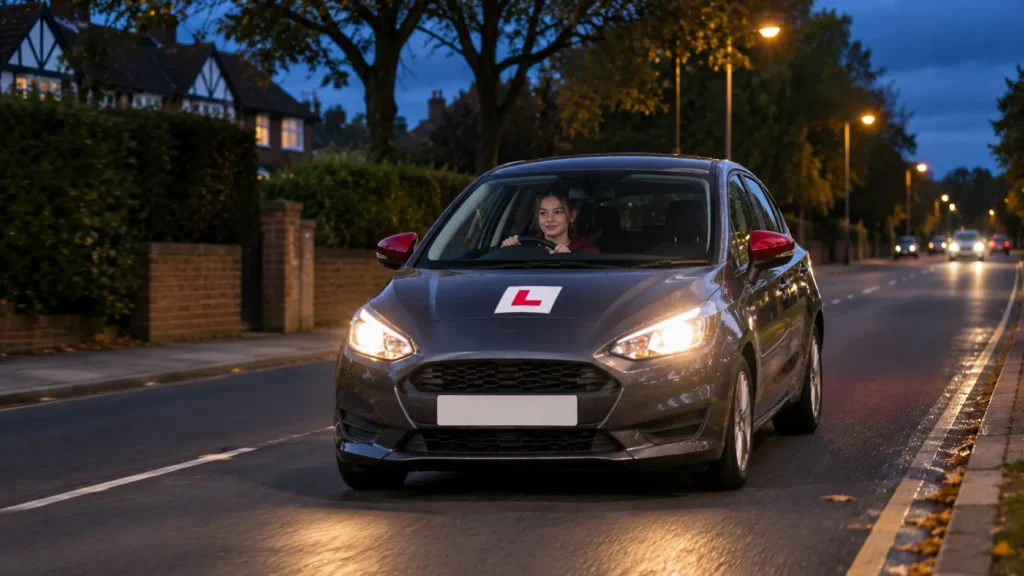
At night, your eyes have less to work with. Colours fade, edges blur and it’s much harder to judge how far away or how fast something is. Also, your eyes take time to adjust from bright light to darkness. So after looking at a brightly lit petrol station, for example, the road ahead can seem very dark for a few seconds.
On top of that, you’re more likely to feel tired at night. So driving at night needs a little more care, a little more space and a little more time.
The Highway Code says to use headlights at night, except on roads with lit street lights. However, you must not use them in a way that dazzles other road users. Also, keep your windscreen and lights clean, because dirt makes glare much worse.
Here are some simple habits that help:
Instructor’s tip
Many cars have automatic daytime running lights, but on some cars the rear lights stay off with them. So on a gloomy evening, don’t trust the bright dashboard. Check your headlights are actually on.
The Highway Code says to drive at a speed that lets you stop well within the distance you can see to be clear. So slow down on unlit roads, especially round bends and over the brow of a hill, where your headlights don’t reach far.
This matters on the country lanes around Shenley, Colney Heath and Harpenden. They can be dark, narrow and winding. So keep your speed down, use full beam when it’s safe, and be ready for something in the road.
Full beam helps you see much further on dark, unlit roads. However, you must dip your lights when you meet oncoming traffic, so you don’t dazzle the driver. Also dip them when you’re following another vehicle, and on bends where they could dazzle someone coming the other way. Read using your car lights correctly for more.
If oncoming headlights dazzle you, slow down, and stop if you need to. Instead of looking at the lights, look towards the left kerb until they’ve passed. Then, once you can see clearly again, build your speed back up.
If a car behind has its full beam on, adjust your mirror to the night setting. Most cars have a small lever on the mirror, and some do it automatically.
If you hit or see an animal in the road, slow down, use your hazard lights if you need to stop, and only get out when it’s safe.
The Highway Code says not to wear tinted glasses or visors at night if they restrict your vision. So if you wear glasses, make sure they’re clear lenses for night driving. Also, if you find night driving much harder than it used to be, get your eyes tested. Your optician can check for problems such as glare sensitivity.
Tiredness is more likely at night, and it’s a major cause of serious crashes. The Highway Code recommends a break of at least 15 minutes after every 2 hours of driving. So plan your stops before you set off.
Warning signs that you’re too tired include:
If you notice any of these, find a safe place to stop, such as a service station. Then have a caffeine drink and a short nap. However, the only real cure for tiredness is proper sleep, so don’t start a long drive late at night if you can avoid it.
Yes, especially in autumn and winter. Many of our lessons take place after dark, which is excellent practice for driving at night.
Your test may take place at dusk or in the dark in winter. So it’s worth being comfortable with night driving before your test.
Pass Plus includes a module on driving at night, so it’s a great way to build confidence after you pass.
Get your eyes tested by an optician. Some conditions make night driving harder, and they can often be helped.
In winter, many of our lessons are in the dark, which is great practice for driving at night. After you pass, our Pass Plus course includes night driving too. Also, read driving in bad weather and driving on country roads.
We give one-to-one manual driving lessons in Borehamwood, Colney Heath, Elstree, Harpenden, Hatfield, London Colney, Radlett, St Albans and Shenley.
A 2 hour lesson is £80, or save £20 with our 10 hour package for £380. We accept all major credit cards and PayPal.