How to stay focused, stay in charge and keep everyone safe when you have passengers.
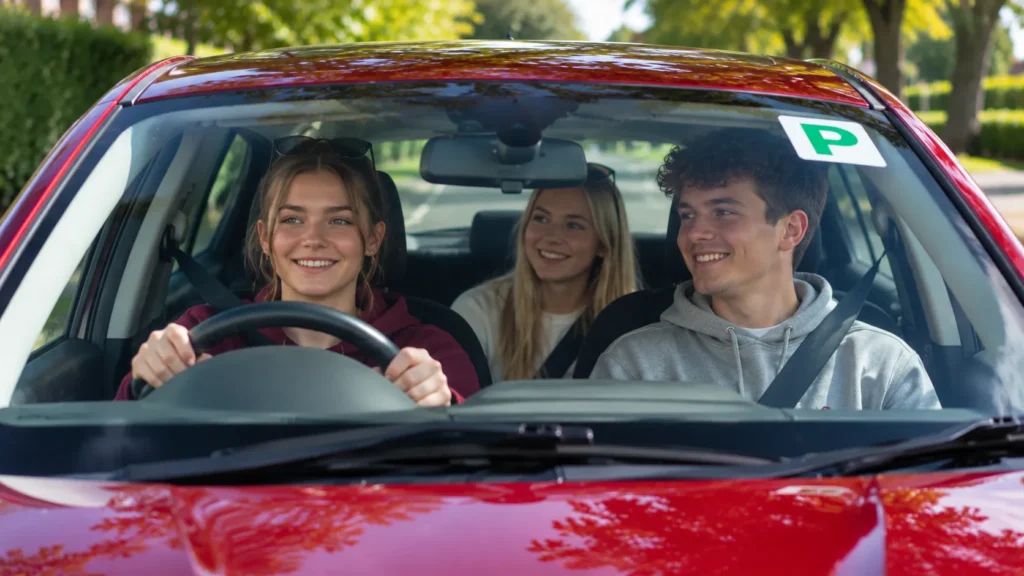
Driving with friends in the car is one of the best things about passing your test. Suddenly, you’re the one giving lifts, heading off on days out and getting everyone home. However, passengers can also be a big distraction, so it’s worth having a plan before you set off. In this guide, we cover why passengers raise the risk, the rules you must know, and simple ways to stay in control.
At a glance
24%
of fatal and serious collisions in 2024 involved drivers aged 17 to 24
6 points
for using a hand-held phone, enough to lose a new licence
14
the age below which you’re responsible for seat belts
Young drivers are more at risk: drivers aged 17 to 24 were involved in 24% of fatal and serious collisions in 2024. Passengers add to that risk, because they compete for your attention. Chatting, music, phones and showing off all take your attention away from the road.
In fact, research suggests that new drivers are more likely to crash when they’re carrying friends their own age. It isn’t because friends are bad people. It’s simply that a full car is noisy, busy and distracting, and new drivers haven’t yet built up the experience to cope with that.
When you’re driving with friends, it’s your car and your licence. So set the rules before you set off. For example:
Most friends will happily go along with it, especially if you explain why. And if someone won’t, they don’t need a lift.
Instructor’s tip
Agree a simple code word with your passengers, such as “quiet”. When you say it, everyone stops talking until you’re through the hazard. It feels silly at first, but it works.
As the driver, you must make sure all children under 14 wear a seat belt or the right child restraint. Passengers aged 14 and over are responsible for their own seat belts, and they can be fined if they don’t wear one. However, it’s still your car, so don’t set off until everyone has their seat belt on.
Also, you mustn’t carry more passengers than you have seat belts. Squeezing an extra friend in the back isn’t worth the risk, or the fine.
Never use a hand-held phone while driving. It’s illegal to hold and use a phone for almost anything while driving, including at traffic lights or in a queue. The penalty is 6 points and a fine. As a new driver, 6 points in your first 2 years means losing your licence.
When you’re driving with friends, ask a passenger to handle navigation or messages, or wait until you’ve parked safely. Also, set your sat nav before you set off, and switch your phone to driving mode.
Sometimes, friends might egg you on to go faster, race another car or show off. It can be hard to say no, especially when everyone’s laughing. But you’re the one who’d face the consequences, legally and personally.
So have a line ready, for example: “I’m not losing my licence for this.” Most people respect that. And if a passenger keeps pushing, pull over somewhere safe and tell them they’ll need to find another way home.
Never drive after drinking alcohol or taking drugs, however little. Also, don’t get in a car with a driver who has. If you’re the driver for the night, stick to soft drinks, and make sure your friends know that from the start.
If a passenger is distracting you, pull over somewhere safe and sort it out. After all, it’s far better to arrive a few minutes late than not at all. Likewise, if a passenger is unwell, upset or causing trouble, stop safely before you deal with it.
A sensible way to build up
| Stage | What to try | Why |
|---|---|---|
| First few weeks | Driving alone or with one calm passenger | Build confidence on familiar roads |
| Next | One or two friends, in daylight | Learn to manage chat and distractions |
| Later | A full car on longer trips | Only once you feel fully in control |
| Late nights | Save these until you’re experienced | Tiredness and busy roads add risk |
Also remember the new driver rules: 6 points in your first 2 years means losing your licence. So build up driving with friends slowly, and don’t let anyone rush you.
If you’re the one in the passenger seat, you can help too. For example, keep your voice down at junctions, help with directions, watch for hazards, and never distract the driver for a laugh. Good passengers make driving with friends safer for everyone.
At the moment, there’s no UK law limiting how many passengers a new driver can carry, beyond the seat belt rules. However, the government’s 2026 Road Safety Strategy includes plans for new drivers, so the rules could change. Also, some insurance policies have conditions, so check yours.
It may. Some young driver policies, particularly with a black box, have conditions or curfews. Always read your policy.
Pull over somewhere safe and sort it out. It’s your car, so it’s your call.
Only if they meet the rules for supervising a learner. Read private practice: how family and friends can help you learn.
Read the new driver rules and your first car insurance as a new driver. Then take a look at our Pass Plus course for extra experience.
Sources: GOV.UK: The Highway Code, rule 100, Using a phone while driving: the law, Department for Transport: Road Safety Strategy 2026.
We give one-to-one manual driving lessons in Borehamwood, Colney Heath, Elstree, Harpenden, Hatfield, London Colney, Radlett, St Albans and Shenley.
Our refresher lessons can help you build confidence on any road. A 2 hour lesson is £80.