Get your car ready, and stay safe on frosty, icy and dark winter roads.
Your first winter after passing brings new challenges: dark evenings, frost, ice and sometimes snow. Suddenly, the roads you drove on your test feel very different. However, with a bit of preparation and a few new habits, winter driving is nothing to fear. Here are our winter driving tips to help you stay safe.
At a glance
10x
longer stopping distances on ice than on a dry road
2x
at least, on wet roads
15 mins
extra to allow on frosty mornings
Preparation is half the battle. So, before the cold weather really sets in, run through these checks:
Read basic car checks for new drivers for how to do each one.
Keep a small kit in the boot, just in case you get stuck or break down. For example:
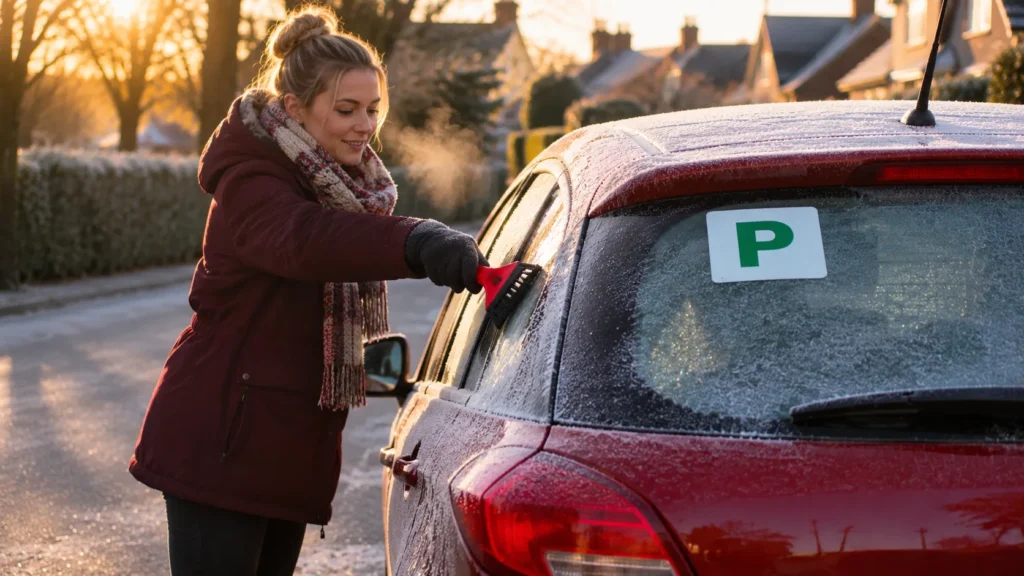
The Highway Code says you must be able to see, so you must clear all snow and ice from all your windows. Your lights must also be clean, and your number plates clearly visible. Also clear snow off the roof, because it can slide down onto your windscreen when you brake, or blow onto the car behind.
So give yourself extra time in the morning, and never drive off peering through a small gap. That’s sometimes called “porthole driving”, and it’s dangerous.
Instructor’s tip
Never leave your car running unattended to defrost it. It’s against the law to leave a vehicle unattended with the engine running, and cars are often stolen this way. Also, don’t pour boiling water on the windscreen, because it can crack the glass.
On ice, your stopping distance can be ten times greater than on a dry road. So leave a much bigger gap. Use a low speed and a high gear, and accelerate, brake and steer gently.
Black ice is especially dangerous, because you can’t see it. So be extra careful where the road is shaded, under bridges and on country lanes, where gritters may not reach. If the steering suddenly feels light, or the road goes quiet, you may be on ice.
If you must drive in snow, take it slowly. Many drivers find that pulling away in second gear, with gentle use of the clutch, helps stop the wheels spinning. Also:
A skid is frightening, but don’t panic. First, ease off the accelerator. Then steer gently in the direction you want to go. Avoid stamping on the brake, because that can make a skid worse. Once you have grip again, carry on slowly.
In winter, the sun sits low in the sky and can be dazzling. So keep your windscreen clean inside and out, keep sunglasses handy, and slow down if you can’t see clearly. Also remember that the drivers coming towards you may be dazzled too.
Winter also brings fog and heavy rain. In fog, use dipped headlights, and only use your fog lights when visibility is seriously reduced. In heavy rain, your stopping distance at least doubles, so slow down and leave more space.
Never drive through deep or fast-flowing water. Even a small amount of moving water can float a car or sweep it away. So if you’re not sure how deep it is, turn round and find another way. Read driving in bad weather.
In winter, much of your driving will be in the dark. So read driving at night and using your car lights correctly.
In heavy snow or ice, ask yourself if the journey is really necessary. However, if you do go, tell someone your route, and check the weather and travel news first. Also make sure you have a full tank or a good charge, plus your winter kit.
Winter driving checklist
| Before you set off | On the road |
|---|---|
| Check the forecast and travel news | Keep a much bigger gap |
| Clear all windows, lights, plates and the roof | Brake, steer and accelerate gently |
| Full tank or good charge | Watch for shaded and untreated roads |
| Winter kit in the boot | Take extra care at junctions and on hills |
They aren’t required by law. However, winter or all-season tyres can give better grip in cold, wet and icy conditions, so they’re worth considering if you drive a lot.
There’s no single answer. Drive slowly enough to stop safely within the distance you can see, and remember stopping distances can be ten times longer on ice.
Use the air conditioning with the heater, and point it at the windscreen. Also, keep the inside of the glass clean, because dirt makes misting worse.
Yes. Our refresher lessons can include winter driving, dark evenings and tricky local roads.
Our refresher lessons can cover winter driving too, including dark evenings and country roads. Also, our Pass Plus course includes all-weather driving.
We give one-to-one manual driving lessons in Borehamwood, Colney Heath, Elstree, Harpenden, Hatfield, London Colney, Radlett, St Albans and Shenley.
Our refresher lessons can help you build confidence on any road. A 2 hour lesson is £80.